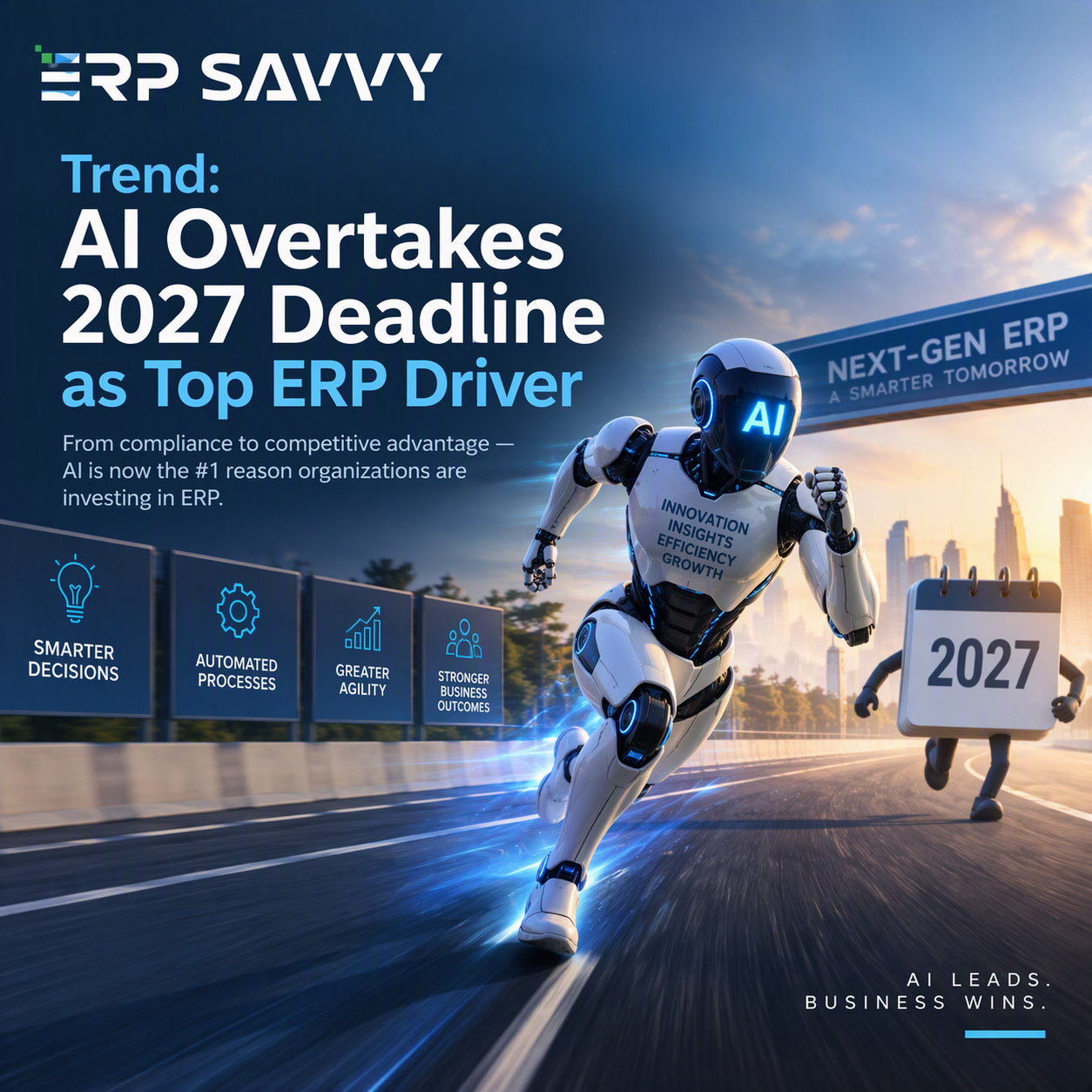
AI Overtakes 2027 Deadline as Top ERP Driver
The #1 reason companies are moving to S/4HANA in 2026 isn't the 2027 deadline anymore. It's AI.
For years, the SAP migration conversation was all about risk: "ECC support ends in 2027, you have to move." That's no longer the argument winning boardroom approval.
A 2026 SAP Insider benchmark of 296 SAP customers found that 43% now name SAP's AI capabilities as the top factor shaping their ERP strategy, ahead of the maintenance deadline itself (39%). The conversation has shifted from "we have to migrate" to "we need this to compete."
Here's what that shift actually looks like on the ground:
→ AI is now embedded, not bolted on. Predictive cash flow, automated three-way matching, real-time inventory optimization. These are shipping inside S/4HANA and SAP Business AI, not as separate integrations you have to build yourself.
→ Migration costs are coming down, fast. SAP's own target is a 35% reduction in transformation effort using AI agents for system analysis, data management, testing, and rollout. Some partners are reporting even higher gains on specific workloads like ABAP conversion.
→ But AI-readiness starts with data readiness. The 2026 Natuvion transformation study found that dirty, duplicated, or fragmented master data is the single biggest threat to AI-driven processes post-migration. 71% of companies in the study adjusted their migration approach mid-project because they underestimated this.
→ There's still a massive execution gap. More than half of SAP customers have moved to S/4HANA, but only a third have fully transitioned. Translation: a lot of companies are paying for a platform they aren't using to its potential.
The takeaway for anyone running SAP today: the business case for migrating isn't "avoid the deadline" anymore, it's "unlock the AI capability sitting in the platform you already licensed." But that only pays off if your data foundation is clean before you flip the switch.
If you're evaluating your S/4HANA roadmap, the real first question isn't "when do we migrate." It's "is our data even ready for what comes after."
What's the bigger blocker for your organization right now: the migration itself, or getting the data clean enough to trust the AI on the other side?


